Plagiarism is something most students have heard about, but it isn’t always as straightforward as copying and pasting someone else’s work.
In academic settings, plagiarism generally happens when you use another person’s words, ideas, research, or work without giving proper credit. Singapore universities take academic integrity seriously. For example, the National University of Singapore’s plagiarism policy explains the university’s expectations surrounding plagiarism and academic work.
The tricky part is that not every plagiarism issue starts with a student deliberately trying to cheat. You might be rushing an assignment at 2am and forget where you got a particular idea from. Or perhaps you’ve paraphrased something so closely that it still resembles the original source.
Throw generative AI into the mix, and things become even more complicated.
So, why can plagiarism result in serious consequences, and more importantly, how can students avoid making these mistakes? Let’s take a closer look.
Reasons Students May Be Penalized for Plagiarism
Schools and universities have academic integrity policies for good reason. Assessments are supposed to reflect your own understanding, skills, and effort.
While the exact rules and consequences vary between institutions, there are several reasons plagiarism is taken seriously.
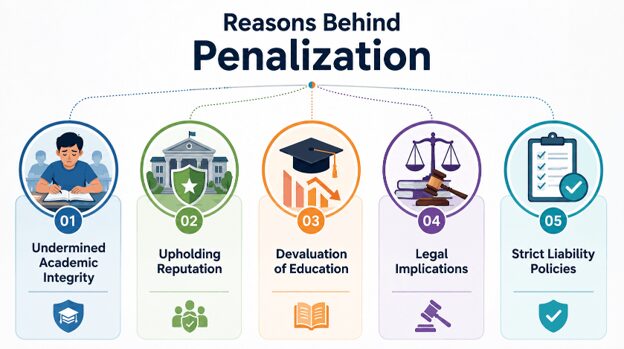
1. It Undermines Academic Integrity
Honesty and trust are fundamental to education.
When students submit someone else’s words or ideas as their own, educators can no longer accurately assess what the student actually understands. It can also create an unfair situation for classmates who completed their work independently.
This is why proper attribution matters even when you’re not directly copying an entire paragraph. If an important idea, argument, statistic, or quotation came from another source, check whether it needs to be acknowledged.
2. It Protects Academic Standards
Schools and universities need their qualifications to accurately represent what their students have learned and achieved.
Academic integrity policies therefore aren’t simply about catching students doing something wrong. They help institutions maintain consistent assessment standards and ensure that grades and qualifications remain meaningful.
For students, understanding these expectations early can save a lot of unnecessary stress later.
3. It Can Interfere With Learning
There’s another, simpler reason to avoid plagiarism: you miss out on actually learning the material.
Researching, analyzing information, and explaining concepts in your own words may take longer than copying something you find online, but those are precisely the skills many assignments are designed to develop.
This becomes especially important at polytechnic and university level, where you’re increasingly expected to evaluate sources, construct arguments, and conduct independent research.
If research is something you struggle with, these tips for developing stronger research skills can help you build better habits before your next major assignment.
4. It May Raise Copyright Concerns
Plagiarism and copyright infringement aren’t exactly the same thing, although there can sometimes be overlap between them.
For example, reproducing substantial copyrighted material without appropriate permission could raise copyright concerns in addition to academic integrity issues.
For most students, however, the practical takeaway is much simpler: don’t use somebody else’s work without appropriate acknowledgement, and always follow your institution’s requirements for citations and permitted use.
5. Institutions Have Their Own Academic Integrity Policies
There isn’t one universal plagiarism penalty that applies to every student in Singapore.
Different schools, polytechnics, and universities may have their own definitions, procedures, and consequences for academic misconduct. The seriousness of a case may also depend on the nature and extent of the issue.
That’s why you shouldn’t rely solely on what your friend, senior, or some random website says is acceptable.
Check your own institution’s academic integrity guidelines. If you’re still unsure, asking your lecturer before submitting an assignment is much better than finding out afterward that you’ve misunderstood the rules.
What Penalties Can Students Face?
The consequences of plagiarism depend heavily on the institution and circumstances of the case.
Depending on the relevant academic policy, consequences could range from being required to redo work or receiving a reduced mark to more serious disciplinary action for significant or repeated academic misconduct.
Rather than assuming that every plagiarism case automatically results in a particular punishment, refer to your institution’s official academic integrity or student conduct policy.
The better approach, of course, is to understand what plagiarism looks like before you submit your assignment.
Common Mistakes That Can Lead to Plagiarism
Some forms of plagiarism are obvious. Others can happen because students misunderstand how sources should be used.
Here are some common mistakes to watch out for.
1. Copying Text Word for Word
This is probably what most of us picture when we hear the word “plagiarism.”
You find a useful paragraph online, copy it into your assignment, and submit it as though you wrote it yourself.
If you reproduce someone else’s exact wording, you generally need to clearly indicate that it is a quotation and provide the appropriate citation according to the referencing style required by your institution.
Simply putting the source in your bibliography at the end may not be enough.
2. Paraphrasing Without Giving Credit
Changing a few words doesn’t automatically make an idea yours.
For example, replacing several words with synonyms while keeping the original author’s argument and sentence structure largely intact can still be problematic, particularly when you don’t acknowledge the source.
Good paraphrasing means first understanding the idea and then explaining it genuinely in your own words and structure.
And here’s the important bit: you still need to cite the original source when the idea came from somebody else.
Instead of trying to make an existing sentence “look different,” concentrate on understanding what it means. Once you genuinely understand the point, it’s much easier to explain it naturally in your own voice.
3. Forgetting In-Text Citations
Imagine you’ve spent hours researching an assignment and carefully listed every source in your bibliography. Sounds safe, right?
Not necessarily.
If you’ve used a particular author’s idea, finding, argument, or quotation in the body of your assignment, you may also need an in-text citation showing readers where that information came from.
Citation requirements differ depending on the referencing system you’re using, such as APA, MLA, or Chicago, so always follow the style specified by your lecturer or institution.
4. Forgetting Quotation Marks
This is an easy mistake to make.
If you reproduce a source’s exact words, a citation by itself may not clearly indicate that the wording has been copied directly.
Direct quotations should normally be clearly identified according to your required referencing style, such as by using quotation marks for shorter quotations together with the relevant citation.
When in doubt, check your institution’s referencing guide.
5. Reusing Your Own Previous Work
Here’s one that sometimes catches students by surprise: you can run into academic integrity problems by reusing your own work too.
Submitting substantial portions of an assignment you’ve previously submitted for another module or assessment may not be allowed unless your institution or lecturer has permitted it.
Rules surrounding the reuse of previous work vary, so don’t assume that something is automatically acceptable simply because you originally wrote it yourself.
If you want to reuse previous research or writing, check with your lecturer first.
6. Using AI Without Checking the Rules
Generative AI has made this area considerably more complicated.
AI tools can be useful for certain tasks, but what counts as acceptable AI use depends on your institution, course, and assessment.
One lecturer might permit AI for brainstorming while requiring you to disclose its use. Another assignment might prohibit generative AI altogether.
Singapore universities are also developing their own guidance around the technology. For example, Nanyang Technological University provides guidance on the use of generative AI, illustrating why students should check the relevant rules rather than assuming that the same approach applies everywhere.
Before using generative AI for assessed work, read your institution’s current policy and the instructions for that particular assignment. If anything is unclear, ask your lecturer.
Most importantly, don’t submit AI-generated material as your own work when doing so breaches the rules of your assessment.
7. Citing Sources You Haven’t Actually Checked
AI and online summaries can make it tempting to cite a source without ever opening it.
That’s risky.
A secondary website—or even an AI tool—could misrepresent the original research, provide incorrect citation details, or refer to a source that doesn’t actually support your argument.
Whenever possible, go back to the original source. Read it yourself, confirm that it supports your point, and record the citation details accurately.
This is good academic practice regardless of whether AI is involved.
Tips to Avoid Mistakes Leading to Plagiarism
Avoiding plagiarism doesn’t require some elaborate system. A few good habits can make the whole process much easier.
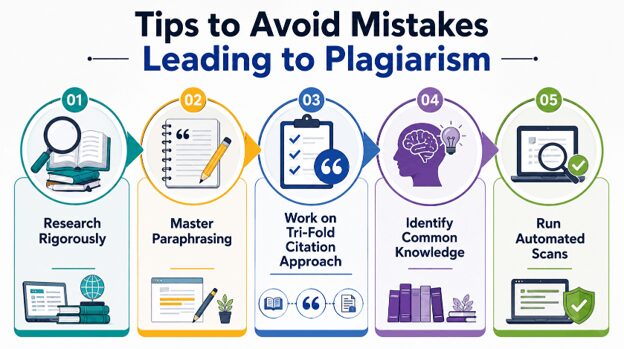
1. Keep Track of Sources From the Beginning
Don’t wait until you’ve finished a 3,000-word assignment to figure out where all your information came from.
As you research, record useful details about each source, such as the author, title, publication, and URL or DOI where relevant.
It also helps to clearly distinguish between direct quotations, your paraphrased notes, and your own thoughts.
Building good research habits early can save plenty of headaches when deadlines arrive.
2. Learn How to Paraphrase Properly
Paraphrasing is not a game of replacing words with synonyms.
Read the original material until you understand what the author is saying. Then put the source aside and explain the idea naturally in your own words.
Afterward, compare your version with the original to make sure you haven’t unintentionally followed its wording or structure too closely.
Remember, paraphrasing usually doesn’t remove the need for a citation. You’re changing how an idea is expressed, not claiming ownership of the underlying idea.
3. Cite As You Write
One of the easiest ways to lose track of sources is telling yourself, “I’ll add all the citations later.”
We’ve probably all had a version of that thought.
A safer habit is to insert citations while drafting. If you’re not ready to format them perfectly, at least leave yourself a clear marker showing which source supports the sentence or paragraph.
Before submission, check that your in-text citations correspond with the references in your bibliography.
You can also read these tips for students dealing with plagiarism for more practical ways to avoid common mistakes.
4. Know What Counts as Common Knowledge
Not every sentence requires a citation.
Widely known and undisputed facts may generally be considered common knowledge, while specific statistics, research findings, distinctive arguments, and other sourced information usually require attribution.
The boundary isn’t always obvious.
If you’re uncertain whether something needs to be cited, check your institution’s referencing guidelines or ask your lecturer.
5. Give Yourself Time to Check Your Work
Many referencing mistakes happen for a very relatable reason: you’re rushing.
If you’re finishing an assignment minutes before the deadline, you’re much more likely to overlook a missing citation, forget quotation marks, or accidentally leave something in your notes that wasn’t meant to appear in the final submission.
Try to complete your first draft early enough to give yourself some breathing room.
For students who regularly find themselves racing against deadlines, improving your time management skills can make assignment periods considerably less stressful.
6. Use Similarity Checkers Carefully
Once you’ve finished your assignment, an additional check may help you spot passages that deserve another look.
A free plagiarism checker can be used as an additional review tool to identify possible text similarities before submission. However, don’t treat a similarity score as a definitive verdict on whether your work contains plagiarism.
A high similarity score doesn’t automatically mean a student has plagiarized, just as a low score doesn’t guarantee that every source has been acknowledged correctly.
The tool should therefore be treated as an extra checking step rather than a substitute for proper referencing.
Ultimately, your institution’s academic integrity requirements are what matter.
A Simple Pre-Submission Check
Before clicking that submit button, spend a few minutes reading through your work one last time.
Ask yourself whether you’ve clearly marked direct quotations, cited ideas and information taken from other sources, checked that your citations accurately represent the original material, and followed the required referencing style.
If you’ve used generative AI at any stage, check that you’ve followed the rules for that particular assessment as well.
It might feel like extra work when you’re desperate to finally submit the assignment and go to sleep, but five or ten minutes of checking can save you a much bigger headache later.
In the End
Plagiarism isn’t something students need to be constantly terrified of. What matters is developing good academic habits and understanding the rules that apply to your work.
Keep track of your sources, cite information properly, learn to paraphrase genuinely, and don’t assume that AI-generated content or reused work is automatically acceptable.
Most importantly, check your own institution’s academic integrity policy. Different schools and universities may have different expectations, particularly as policies surrounding generative AI continue to evolve.
Good academic writing isn’t about finding clever ways to beat a plagiarism detector. It’s about showing what you’ve learned while being transparent about where your information and ideas came from.
Once you build that habit, avoiding plagiarism becomes much less stressful—and your writing will usually become stronger along the way.
 Facebook