

Bullion is any precious metal, like gold or silver, that is valued specifically for its weight and purity rather than its face value or artistic design.
While a quarter in your pocket is worth twenty-five cents because the government says so, a one-ounce silver bar is worth whatever the global market price for silver is at that exact second.
There are 25,000 metric tons of silver mined every year on average, and a massive chunk of that is refined into the bars and coins that collectors and investors call bullion. It is the rawest form of wealth you can hold in your hand.
When you buy bullion, you aren’t paying for the history of a rare coin or the brand name of a piece of jewelry. You are buying the element itself.
Most people start with silver because it is accessible. It allows you to learn how markets move without needing a massive bank account.
Understanding how this works means considering three specific factors: the spot price, the premium, and the physical form of the metal.
Understanding Spot Price And Physical Premiums
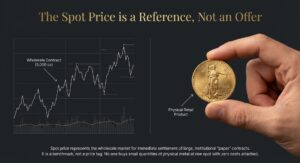
The spot price is the current trading price of a raw ounce of metal on the global market.
It fluctuates constantly based on supply and demand, much like the price of a stock or a gallon of gas.
However, you can’t actually buy physical metal at the spot price because it costs money to refine, mint, and ship it to your door.
This extra cost is called the premium. If silver is trading at $30 an ounce and a shop sells you a bar for $33, that $3 premium covers the labor of making the bar and the profit for the business.
As you browse different silver bars and rounds to see how prices change, you will notice that the premium usually decreases as the item’s weight increases.
It’s an example of how online research into resources that offer real-time pricing provides a clear overview of what might otherwise be a hypothetical concept.
Buying in bulk is a classic math problem. A one-ounce round might have a $4 premium, but a ten-ounce bar might only have a $25 total premium.
If you do the math, the ten-ounce bar saves you $15 because the mint only had to strike one piece of metal instead of ten individual ones.
How Supply And Demand Control The Value
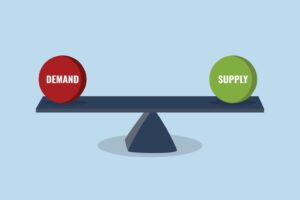
Precious metals are a finite resource, meaning there is only so much of them in the Earth’s crust. Estimates vary, but some predict that gold makes up as little as 0.0001 parts per million.
When tech companies need more silver for solar panels and electric vehicle batteries, the demand goes up. If the mines cannot keep up with that pace, the price of bullion climbs.
This is a core lesson in economics that applies to everything from sneakers to silver.
When you own bullion, you are essentially betting that the demand for that metal will remain high while the supply remains difficult to find. Silver is unique because it is both a financial asset and an industrial necessity.
Inflation also plays a massive role in why people hold bullion.
When the government prints more money, each individual dollar loses a little bit of its “purchasing power,” meaning it takes more dollars to buy the same loaf of bread.
Because you cannot just “print” more gold or silver, bullion often holds its value even as the dollar shrinks.
Physical bullion comes in several distinct formats that every new buyer should recognize:
- Sovereign coins minted by government mints like the US Mint
- Privately minted rounds which look like coins but have no face value
- Cast or struck bars ranging from one gram to 100 ounces
Doing The Math On Tiered Pricing Models

When you look at a professional bullion catalog, you will see different price points for the same item.
This is called tiered pricing. Dealers want to encourage you to buy more at once, so they offer discounts when you reach certain volume milestones, such as buying 20, 100, or 500 ounces at once.
Imagine you want to buy silver rounds. If you buy 1 to 19 rounds, the price might be $35.00 each.
If you buy 20 to 99 rounds, the price drops to $34.50. This fifty-cent difference might not seem like much on one coin, but on a tube of 20 coins, you have saved $10 simply by reaching that next tier.
Calculating your “all-in” cost is the first step to becoming a smart buyer.
You take the price per ounce, multiply it by the quantity, and add any shipping or insurance costs. Minimizing your cost per ounce is the only way to ensure your investment grows over time.
Moreover, this is a good exercise even if you’re not going to learn to invest. Aiming to maximize your math comprehension is easier when you translate problems into real-world concepts.
Starting Your Precious Metals Education

The best way to understand these concepts is to watch how they play out in the real world.
Tracking the spot price for a week will show you how volatile metals can be. You will see how news about the economy or new technology can send prices up or down within hours.
Bullion isn’t a get-rich-quick scheme.
It is a long-term way to store the value of your hard work. By learning the math behind premiums and the science of purity now, you are building a foundation of financial literacy that will serve you for the rest of your life.
You can find more detailed guides on all sorts of topics on our educational blog, so there’s no need to look anywhere else for all the insights you need.

 Facebook